CIC Maker
Every food factory needs Cleaning Instruction Cards for its BRC audit – one per machine, telling an operator exactly how to clean it. Most sites make them inside their chemical supplier's software, which means they don't really own the documents that keep them audit-ready. I built CIC Maker so a site can make and keep its own. Version 1 is still free online. Version 2 has spent the last couple of months being put to work on a real factory floor and shaped to fit what that floor needs. It has grown from a card maker into the training and the records that hang off every card.
The problem
A Cleaning Instruction Card is a legal document. It tells an operator exactly how to clean one machine – the chemical, the dilution, the PPE, the steps, the checks. When an audit lands you have to produce the right card for every piece of equipment, current and correct.
The usual way to make them is the chemical supplier's system. It works, but the cards live in their software, on their terms, and changing supplier can take the work with them. Making a card by hand instead is slow and easy to get subtly wrong. And either way the harder question is left open: when someone edits a card, how does anyone know the copy already printed and hanging by the machine is the one being followed?
Then there's how the card gets used. People should be trained on it and sign that they've learned it. In most places they just sign against it, so the auditor sees a signature. I'm not surprised, because most cards look like this: Lock off. Remove debris. Rinse. Spray chemical. Scrub. Rinse. Nobody can be trained on that.
The solution
Most software for food sites is built to fit every factory at once, and that's one reason it's so often hard to use. With version 2 I went the other way: build the system, then fit it to the factory it runs in. It runs on a server, so a card started on a phone at the machine can be finished on a computer in the office. Staff sign in with their own account, and each person gets only the rights they need – edit cards, approve them, train people, or manage who has access.
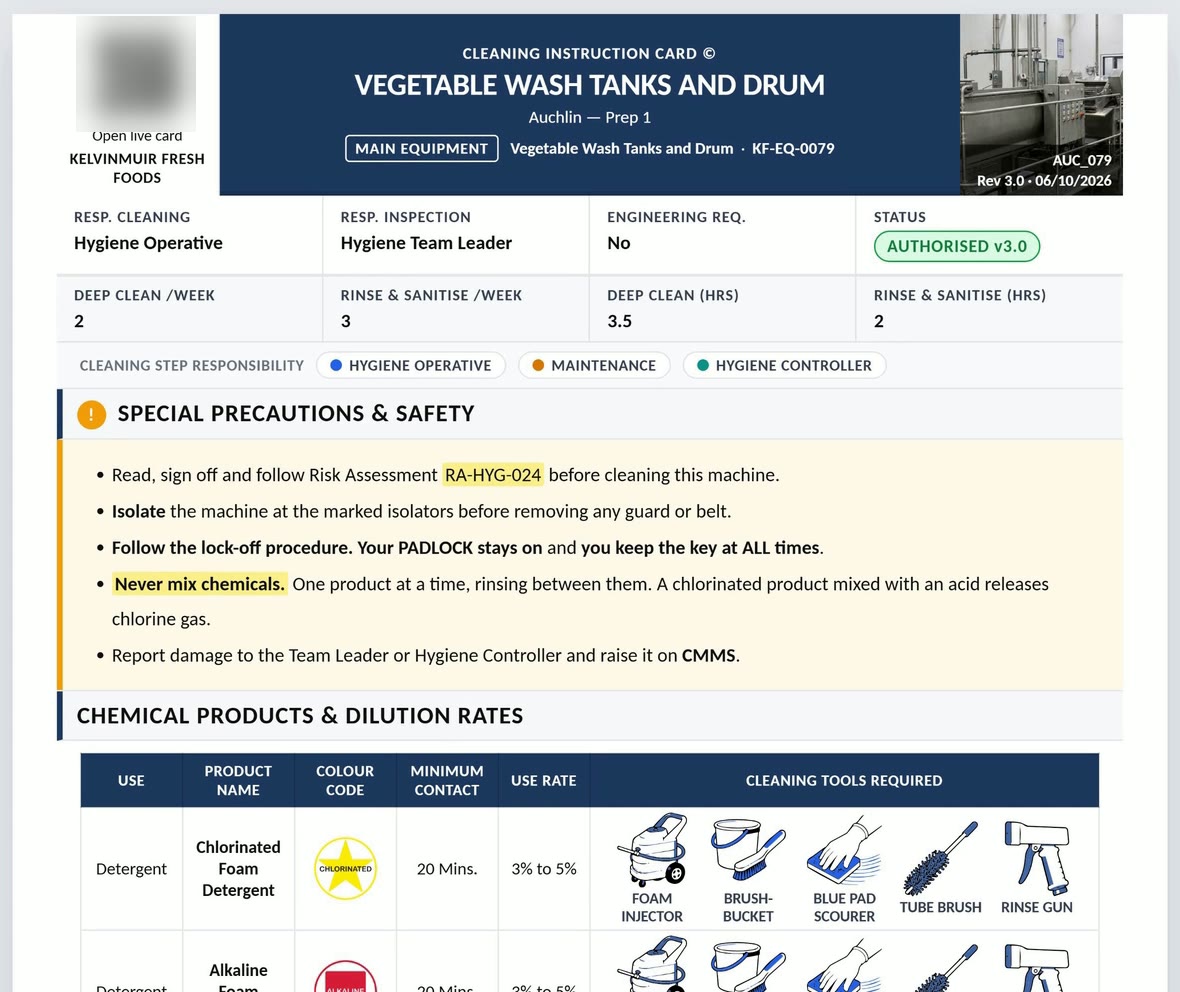
- A card you can click, not a picture of paper. The card is a web page. Tap a chemical and its safety data sheet opens. Tap a linked procedure or the risk assessment number and that opens too, and any photo opens full size. One tap switches the whole card between English, Polish, Romanian, Russian and Czech. Every card gets its own QR code: scan it, sign in, and you see the current approved card. You can still print it or save it as a PDF, but you don't have to.
- Written by the people who clean the machine. I've seen cards written in an office for machines the writer had never cleaned. So the editor had to be simple enough for the cleaning team. On a computer it shows the card map, the section you're editing, and the finished card changing as you type. Tablets and phones get their own layout, and the map ticks off each finished section so you can see what still needs work.
- The card follows your machine. Add a block from over twenty kinds and give it any title, such as a disassembly guide or a changeover check. Pick a cleaning tool and its colour so the card matches your colour-coded kit. Each chemical carries its colour code, every card wears its area's colour band, and each step is coloured by the role that does it. Link a video of a hard strip-down and it prints on the card with its own QR code.
- It knows how the machine is put together. Under every card sits the equipment register: every machine on the site, with its number, its area and how often it's cleaned, filled once from the list the site already keeps. You pick the machine instead of typing it, then say what it's made of – four spray bars, a drum, two filter units. Each part is written once, as its own card, and linked to every machine it belongs to. The machine also opens as a 3D model, and tapping a part turns the model to show you where it is. Right now I set up each model myself.
- Every card is a training course. The course is built from the card, section by section, so the training always matches it. Train up to twenty people as a group, or one person on a tablet. Tick a machine and its parts come with it, and anything already signed at its current version is skipped. The course is read aloud as it plays, so someone who struggles to read can still follow by listening. The content changes language while the buttons stay in English for the trainer. Chemical training runs the same way, with a test and a certificate.
- A record an auditor can check. At the end the trainee signs, the trainer signs, and the record is locked. It can't be edited, only voided with a reason, and the reason is kept. Every printed record carries a QR code that shows, live, that it's genuine and hasn't been voided. Each session lands in the training matrix, and when a card changes in a way that matters, everyone trained on the old version is flagged for retraining.
Getting a whole site's cards across
A site doesn't need one card. It needs one for every machine, and most already have a pile of old ones. A script could move them across, but it would carry the six-line style straight into the new system. So I built the CIC Workshop, an AI assistant you talk to while standing at the machine. It already knows the site's chemicals, with their usual dilution and contact time, and the equipment list. It asks for photos, asks about what it sees, and questions any dilution outside the usual range. It works in English, Polish or Czech. A few minutes later there's a draft card with steps, pinned photos and your team's languages. Someone in hygiene or management then reviews it, adds what's missing and signs it off.
What changed
Version 2 is being put to work at a BRCGS-certified Scottish food manufacturer, and it isn't available to the public. The biggest change is what the card is for. It used to be the end of the job. Now the training, the records and the matrix are all built from it.
Version 1 is still here, and still free. It's a single web page that works fully offline, with no account and no server. You get draft-to-authorised cards with a DRAFT watermark, a change log that can't be rewritten, the same five languages, and your data in a folder you choose. It's free to use for any purpose, commercial included, and the source is there to read. If you just need good cards for one site, it's a good place to start.
What I want to build next
Some of this is already on the way. The biggest piece is the daily cleaning sign-off. Today each person signs a paper sheet after every clean, often ten or fifteen rows a day. Because the system already knows which parts make up which machine, it is meant to replace all of that with a tablet, the machine you cleaned, and one signature. Also coming: a weekly offline copy saved to your own drive automatically, connecting to a company's own server if it already runs one, and uploading the equipment list as a spreadsheet.
After that: a 3D model built by AI from photos taken all the way round the machine, videos kept inside the system, the CIC Workshop knowing each machine's parts, and other courses, like pest control, running the same way as chemical training. None of that is built yet. It's where the tool goes next, not what it does today.
Try version 1, or get in touch
Version 1 is live and free to use. Open the worked example and you’ll see a finished card before you build anything.
Version 2 isn’t available to the public. It runs at one food factory and is being shaped around that site. If you’re interested in bringing something like it into your own factory, or in helping with where it goes next, get in touch.